Otranto: town, beaches and the cave coast.
A small walled town on the Adriatic side of the Salento, with a cathedral floor that took three years to lay, sandy bays to the north and cliffs to the south. How to get there, what to see, where to swim, the rules at the Grotta della Poesia and where to stay. Checked on 12 November 2026.
Small town, two very different coasts.

Otranto is on the Adriatic coast of the Salento, south-east of Lecce. Its old town is a compact knot of white lanes inside walls and bastions, with the Aragonese castle at one end and the cathedral at the top. Below, a short town beach and the harbour face water clear enough to look shallower than it is.
The town takes half a day. The reason to stay is the coast. According to the Comune di Otranto, the harbour divides two quite different shores: to the north, an almost entirely sandy, flat coast with the Alimini lakes and their pine woods; to the south, cliffs and inlets running from Capo d’Otranto towards Porto Badisco.
Otranto is busy in August and very quiet in winter. It’s easiest with a car, though the summer bus network from Lecce makes a car-free stay workable in season.
Before you travel: fares, schedules, opening hours, beach rules, tax rates and season dates change every year, and the details on this page were checked in November 2026, so some may be out of date. Always confirm current prices, times and rules with the operator or the official site, or locally, before you travel.
Otranto and its coast, at a glance
Sand to the north, rock to the south. Pick by the swim you want and the wind on the day.
| Place | What it’s like | Getting there | Good to know |
|---|---|---|---|
| Otranto town | Walled old town, cathedral, castle, small town beach | On foot from anywhere in town | Seasonal ZTL cameras in summer |
| North: Alimini and the bays | Long sandy beaches, coastal lakes and pine woods | Car; summer buses on the coast road | Beach clubs and free stretches |
| Torre dell’Orso and Melendugno | Big sandy bays further north | SalentoinBus line 101 in summer | Blue Flag beaches in 2026 |
| Roca Vecchia | Archaeological site and the Grotta della Poesia | Car or line 101 in summer | No swimming or diving; ticketed in summer 2026 |
| South towards Castro | Cliffs, coves and sea caves | Car on the coast road; boat trips | Rocky: bring water shoes |
Blue Flag details from FEE Italia’s 2026 list. For more Salento beaches, including access to the bays north of town, see our best beaches in Puglia guide.
Check locally: these fares, times and dates were published in 2026 and may be out of date. Confirm them with the operator or the official site, or locally, before you travel.
How to get to Otranto
There’s no mainline station. FS Sud Est runs from Lecce via Zollino to Maglie, and on to Otranto on a branch line: the RFI timetable for Lecce lists a few through services. In practice the last leg is often a bus. From 14 September 2026, the Maglie–Otranto section was run by replacement buses on weekdays (reported by Gazzetta del Mezzogiorno, 9 September 2026). Check current fares/times on the FS Sud Est site and look at which legs are buses before you buy.
In summer, the Province of Lecce’s SalentoinBus network is simpler. In 2026 it started on 13 June and ran into September, with fast direct runs and evening services to Otranto. Line 101 runs between Lecce, Torre dell’Orso and Otranto, with a stop at the Grotta della Poesia. Seats are booked ahead; check current fares/times.
By car, Otranto is an easy drive from Lecce, and a car is the only practical way to explore the cliffs to the south out of season. Brindisi and Bari are the nearest airports; see our getting around Puglia guide for transfers and car hire.
Driving and the ZTL
Park outside the walls. Parts of the old town are closed to traffic, and from 15 June to 15 September 2026 the council also switched on its seasonal ZTL cameras: Via Cappuccini from 20:00 to 06:00, and Via San Francesco di Paola from 18:00 to 06:00. If you’re staying inside the walls, ask your host how to arrive with luggage.
What to see in Otranto
Start at the cathedral early, before the groups, then walk the walls to the castle.
The cathedral floor
The archdiocese says the floor mosaic covers the nave, transept and apse. It was commissioned by Archbishop Gionata and laid by a priest called Pantaleone between 1163 and 1165, telling the “history of salvation”. Look down as much as up.
The martyrs’ chapel
In 1480 an Ottoman force took Otranto and turned the cathedral into a mosque. A chapel built in the early 1500s holds the relics of the townspeople killed then; the Church remembers them every 14 August, according to the archdiocese.
Older layers
When the nave mosaic was lifted for restoration in 1986, workers found remains of an early Christian church, a late Roman mosaic from the 4th or 5th century and two Messapian tombs. Take a moment in the crypt if it is open.
The Aragonese castle
An imposing fortress at the edge of the old town, now used by the council as a venue for exhibitions and events. Check the council’s castle page for what’s on and current tickets.
Bastions and seafront
Walk the walls and the promenade towards the harbour at dusk. The town beach below is small, sandy and very busy in August.
The Palascìa headland
South of town, the coast road leads towards the Palascìa lighthouse on its cape. Go early or late for the light, and keep well back from the cliff edges.
Beaches and caves around Otranto
The sea is clearest on calm days. With a strong onshore wind, cross to the Ionian side near Gallipoli instead.
North of town. The flat, sandy coast runs past the two Alimini lakes, which the council describes as different in character: Fontanelle is fed by a freshwater spring, and Alimini Grande is brackish and fed from it by a channel. Maritime pines back much of this shore, and the sandy bays here are the easiest swimming near Otranto, with beach clubs and free stretches. Further north, Torre dell’Orso and the rest of Melendugno’s coast held Blue Flag status in 2026; Otranto itself wasn’t on the 2026 list.
South of town. Past the harbour the coast rises into cliffs and small inlets. Swimming is from rocks and ladders, and you need to choose your entry carefully on any day with a swell. Further south, Castro’s La Zinzulusa and La Sorgente stretches were also on the 2026 Blue Flag list, and boat trips visit the sea caves in season.
Puglia’s 2026 beach ordinance set the bathing season from 23 May to 13 September; lifeguard cover and beach services follow that season, so take extra care outside it.

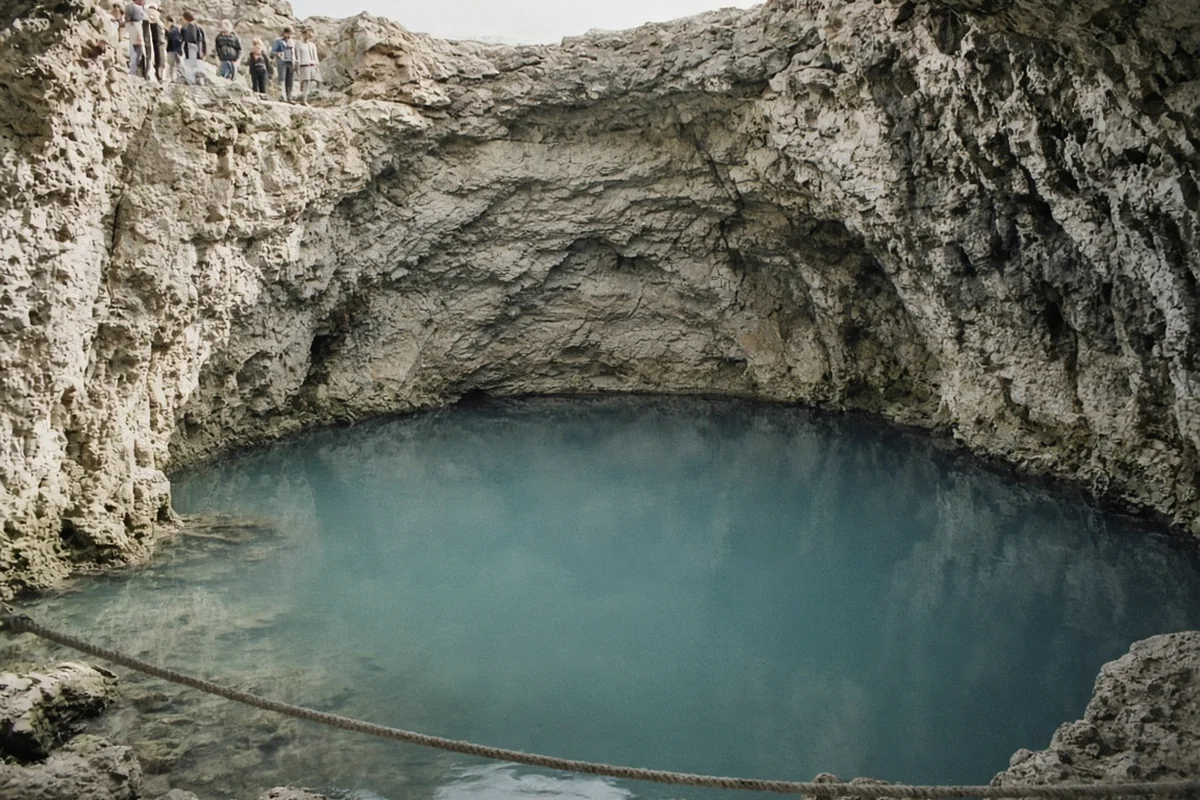
Go to look, not to swim.
The famous pool is part of an archaeological site.
The Grotta della Poesia is at Roca Vecchia, north of Otranto in the municipality of Melendugno. From July to the end of September 2026, visitors who weren’t Melendugno residents paid €5 to enter the Roca Vecchia area (reported by Lecce Tomorrow, 20 July 2026). Paying doesn’t allow swimming or diving, which remain banned under existing orders (reported by idealista/news, 19 August 2026). For current tickets and opening times, check the site manager, ArcheoRoca.
More than a photo stop
Give the whole site an hour, not just the cave rim.
A fortified settlement
According to ArcheoRoca, a fortified settlement stood on the promontory from the 17th century BC, with close links to the Minoan and Mycenaean Aegean. It was destroyed in a siege in the 14th century BC, and the excavations show traces of it.
Walls and a sanctuary
In the 4th and 3rd centuries BC the site was resettled inside walls about 1,400 metres long. The smaller of the two caves, the Poesia Piccola, was a sanctuary, and its walls carry hundreds of ancient inscriptions.
Visiting
Most paths are rocky and unshaded. Go early or late in summer, wear proper shoes and carry water. For a swim afterwards, use the Blue Flag beaches along Melendugno’s coast rather than the rocks by the caves.
Where to stay in and around Otranto
Three kinds of base. We don’t quote room rates, which change daily.
Inside the walls
B&Bs and small hotels in old houses, a few minutes from the town beach and the harbour. Best for evenings on foot. Ask about parking and the ZTL before you arrive, and expect noise on August nights.
Just outside the walls
Hotels and apartments with easier parking and a short walk in. A sensible base with a car, and handy for the summer bus stops.
The sandy north
Holiday villages, campsites and resort hotels near the beaches north of town. Good for families in June or September; you’ll drive into town for dinner. Compare Salento bases in our where to stay in Puglia guide, or base yourself in Lecce and visit for the day.
Five things to check before you go
Your bus dates
SalentoinBus only runs in summer. Outside it, check the FSE train-and-bus link via Maglie, and check current fares/times for your date.
The ZTL
Ask your host where to park. The seasonal cameras ran from 15 June to 15 September in 2026, and parts of the old town are closed all year.
Cave rules
Don’t plan a swim at the Grotta della Poesia. Check ArcheoRoca for the current ticket and opening arrangements.
Wind
If the Adriatic is rough, try the Ionian side. Our Puglia beaches guide covers both coasts.
Season
Many beach hotels close outside summer. See our best time to visit Puglia guide.
Frequently asked questions
Is Otranto worth visiting?
Yes. The walled old town and the cathedral mosaic are worth half a day, and the coast either side, sandy to the north and cliffs to the south, is some of the best in Puglia.
How do I get from Lecce to Otranto without a car?
In summer, take SalentoinBus line 101. The rest of the year, FS Sud Est runs via Maglie, often with a bus for the last leg. Check current fares/times on the operator sites for your date.
Can you swim at the Grotta della Poesia?
No. Swimming and diving are banned. In summer 2026, non-residents paid €5 to visit the Roca Vecchia area (reported by Lecce Tomorrow, 20 July 2026); check ArcheoRoca for current arrangements.
Where are the sandy beaches near Otranto?
North of town, along the flat coast past the Alimini lakes and on towards Torre dell’Orso. See our best beaches in Puglia guide for access and parking.
Otranto or Gallipoli?
Otranto for clear water, cliffs and a quieter old town on the Adriatic. Gallipoli for long sandy beaches and nightlife on the Ionian side. Many visitors base themselves in Lecce and visit both.
Otranto sorted. Now plan the rest of the Salento.
Go back to our Puglia travel guide for Lecce, the Ionian coast and the trulli.
Explore the Puglia travel guide →More clear water: Villasimius in Sardinia → or Sicily’s beaches →